
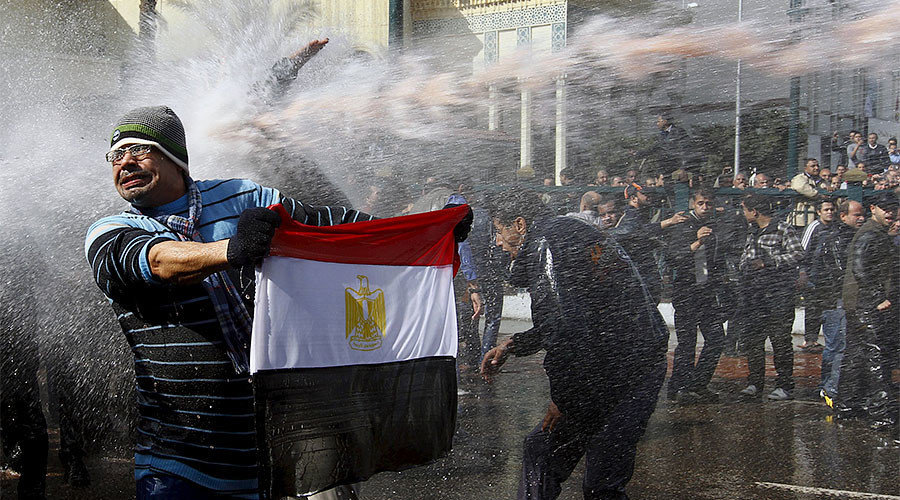
© Yannis Behrakis / AFPEn protestant holder det Ægyptiske flag, mens han står foran vandkanoner ved urolighederne i Cairo den 28. januar, 2011
"Eksporten af værdier fortsætter med at så kriser i internationale relationer. Denne eksport af værdier og kravet om kun at følge et Europæisk perspektiv igangsatte krisen i Ukraine," sagde den russiske udenrigsminister Sergey Lavrov.
"Eksporten af værdier ledte til det såkaldte "arabiske forår" og gav anledning til eksporten af flygtninge til Europa," sagde Lavrov ved en pressekonference om resultaterne af det russiske diplomati i 2016. Han bemærkede, at ud fra dete synspunkt, er de nuværende vestlige værdier ikke traditionelle for Europa selv.
"Hvis vi taler om Vesten, er de europæiske værdier, som vi konstant mindes om som værende eksemplariske, de er ikke værdier som forfædrene til de moderne Europæere bekendte sig til, de er noget nyt, moderniseret."
"Jeg ville beskrive dem som postkristne værdier, der er i fundamental modstrid med vores lands værdierne, som vi ønsker at beholde og videregive," sagde Lavrov.
Kommentar: Delvist oversat af Sott.net fra Lavrov reminds Western 'messiahship' bred Ukrainian crisis, Arab Spring and the refugee flood
Angående traditionelle værdier se også:
The liberal world - tales from utopia
Pope Francis: Bearing witness to the faith requires "word, heart and hand"
He called the attempt to impose these 'post-Christian values' on Russia "indecent from the humane point of view," and "a colossal mistake and unacceptable revaluation of one's own influence on international relations."
The top Russian diplomat pointed to the West's attempts to impose democracy on the Middle East and summarized the gruesome outcome, especially regarding the local Christian populations.
"After the outbreak of hostilities in the Middle East, the number of Christians in Iraq has decreased four times, in Syria - dramatically more," he said, adding that this "once again confirms the inhuman character of the 'liberal values' for which 'authoritarian regimes' are being destroyed."
He also noted that Moscow is highly concerned that the international community is still unable to create a united front against terrorism.
"This causes serious concern and regret. Why is this happening? There may be many reasons."
"We see that the problem of forming common ranks to fight terrorism, organized crime, drug trafficking, many other threats, this problem is becoming systemic," he stated, noting that possible joint efforts in these spheres are hampered by contradictions in the basic principles of foreign policies of partnering states.
"These are either pragmatism, [the focus on] well and correctly understood national interests, or messiahship, the desire to spread one's values around the world, in the form in which they have been developed in this particular group of countries," Lavrov said, referring to the US, EU, and NATO.
He noted that Russia, for its part, is open to cooperation with these partners on pressing global issues, but only in a climate of mutual respect, and without attempts at importing their values into Russia.
"We are looking for closer ties with those who are ready to work with us on the basis of mutually beneficial cooperation, respect of one another's interests and balance of interests," Lavrov told reporters.
'Cooperation with Trump's team expected to be more effective, but Russia remains realistic'
Answering questions from reporters, Lavrov noted that Russia hopes cooperation both on settling the Syrian crisis and on fighting terrorism will be more productive with the incoming Trump administration than it has been with Obama.
"I hope that our cooperation on the Syrian crisis, as well as on other issues related to the fight against terrorism will be more effective than with the Obama administration."
"It is quite possible to breathe new life into these mechanisms, considering that the new US administration claims it aims to combat terrorism for real," Lavrov said. He stated that Russia welcomes the decision of the incoming US president to make the fight against terrorism a priority during his time in office.
"When we hear that Donald Trump regards combating terrorism the top priority of his foreign policy, of course, we can only welcome this decision, because this is what our US partners have so far lacked."
"We heard Donald Trump and his team say they will approach it differently and avoid double standards instead of using them to pursue goals," the minister went on to say.
He noted, however, that Russia is realistic and cautious when it comes to expectations regarding the new US administration.
"We are realists; we follow, of course, the new US administration's preparation for assuming office. I would not go to the extremes: at the moment there are a lot of forecasts, speculation in the media and in the political science community, some are looking forward to new developments, and some say that nothing will change," the minister said, adding that the intentions of the new US administration regarding the rest of the world will only be clear after it starts its work.

Læserkommentarer
dig vores Nyhedsbrev