
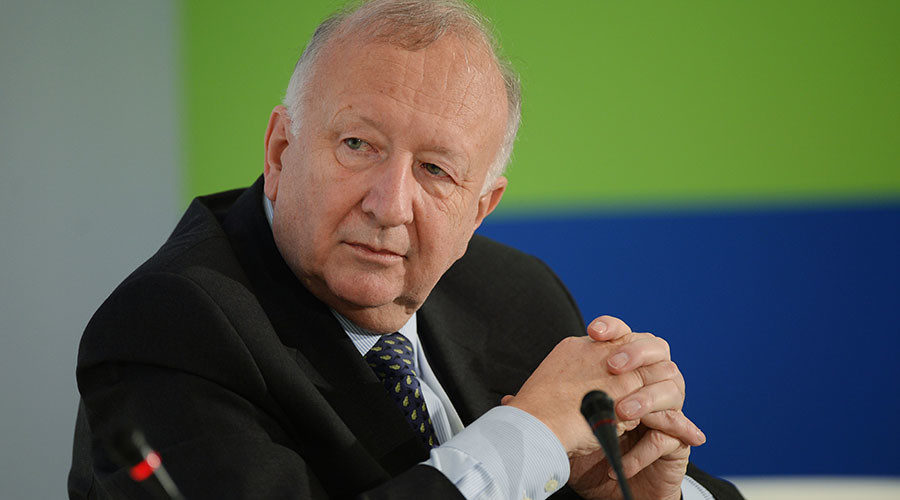
© Mikhail Voskresenskiy / SputnikWilly Wimmer, tidliger det tyske parlaments statssekretær i det tyske forsvarsministerium og forhenværende vicepræsident i OSCE's Parliamentary Assembly.
"Jeg mener, vi har en katastrofal situation i EU og står allerede i nogle år, overfor en situation, hvor de gør deres yderste for at skabe en fjendtlig situation mod den Russiske Føderation..." fortalte Willy Wimmer også tidligere statssekretær for den tyske forsvarsminister RT's SophieCo.
"...Og når det kommer til pressen, og når det kommer til at påvirke befolkningen, så brugte de virkelig Moskva som et værktøj for deres eget formå" Han fortsatte, idet han svarede på et spørgsmål om ubegrundede beskydninger om, at Rusland blander sig i tysk politik i et forsøg på at påvirke det føderale valg:
"Jeg mener, det er interessant, at selv det tyske føderale sikkerhedsvæsen lige har fortalt medierne, at der ikke er nogen indflydelse fra den Russiske Føderation, der ser ud som en disinformationskampagne. Så jeg tror, at de i Berlin og Bruxelles står over for en interessant situation. Igen, så må de arbejde med deres egne problemer og ikke bruge Moskva som en undskyldning."
Kommentar: Delvis oversat af Sott.net fra EU uses Russia as 'tool', creates hostile situation says former OSCE Assembly VP Willy Wimmer
The former OSCE Parliamentary Assembly vice president went on to state that Western Europe has feared two things for decades.
"The first is to start a war and have a European battlefield and the second fear is to face something like a US-Russian condominium on Europe," he said referring to a statement by Germany's Vice-Chancellor and Foreign Minister Sigmar Gabriel, in which he said the US and Russia should find common ground - but not at the expense of Europe.
When it comes to European sanctions against Russia, Wimmer said they are in place "because of the coup d'etat in Kiev, which has been organized by the West."
"Why do we have sanctions against the Russian Federation? There's no reason," Wimmer said, adding that such sanctions hurt the EU's own interests and noting that the bloc will likely follow suit if President Donald Trump removes US sanctions against Russia.
When it comes to NATO, Wimmer accused the alliance of being "outdated."
"NATO is outdated, not only because of the remarks of President Trump that NATO is obsolete. NATO is outdated because the European Parliament, the European population never in history voted for NATO as an aggressive alliance. NATO was a defensive alliance and should be restricted on German territory as such. What we see in these days is NATO at the Russian-Western border. This was never in our interest and is never backed by international rules and regulations..." he said.
Wimmer added that if Trump were to start a debate on the alliance's role and legal structure, such a discussion would be "in favor of the European population."
Meanwhile, Wimmer stated that although Merkel criticized Trump's travel ban for citizens of seven mainly Muslim countries, secure borders are also in the interest of Germany and Europe as a whole.
"We are interested in having secure borders, no wars on the other side of the border and no refugees coming by hundreds of thousands to our countries. We should help them live in their own countries and not destroy them, and not destroy the future of these people," Wimmer said.
He went on to accuse Merkel of opening Germany's borders and "not acting on the basis of our law."
"We live in a situation where we never lived in before - the German government has to be based on our own laws. When we allow the federal chancellor to do her own business, we are facing a critical situation and when it comes to hundreds of thousands of people of whom we don't know that they are in the country, of whom we don't know about their names, their background - I think we never saw, in modern European history, a country being organized like this," he said.
Wimmer said that when it comes to terrorism situations in various Western countries, we must "blame our own governments for not obeying our own laws" and therefore causing such security problems.
Merkel will stand for re-election in the federal election in September. Whether or not she succeeds in beating out top contender Social Democrat Martin Schulz will, according to Wimmer, depend on other German election outcomes, as well as elections in other Western European countries.
"...All these results will have a major effect on the inner German situation, because in the very moment we all have the feeling, when it comes to Europe, we live on a hand grenade. It can explode every second and this will have a major influence on the German elections in September," he said.

Kommentar: Wimmer making a lot of sense but is Europe listening?