
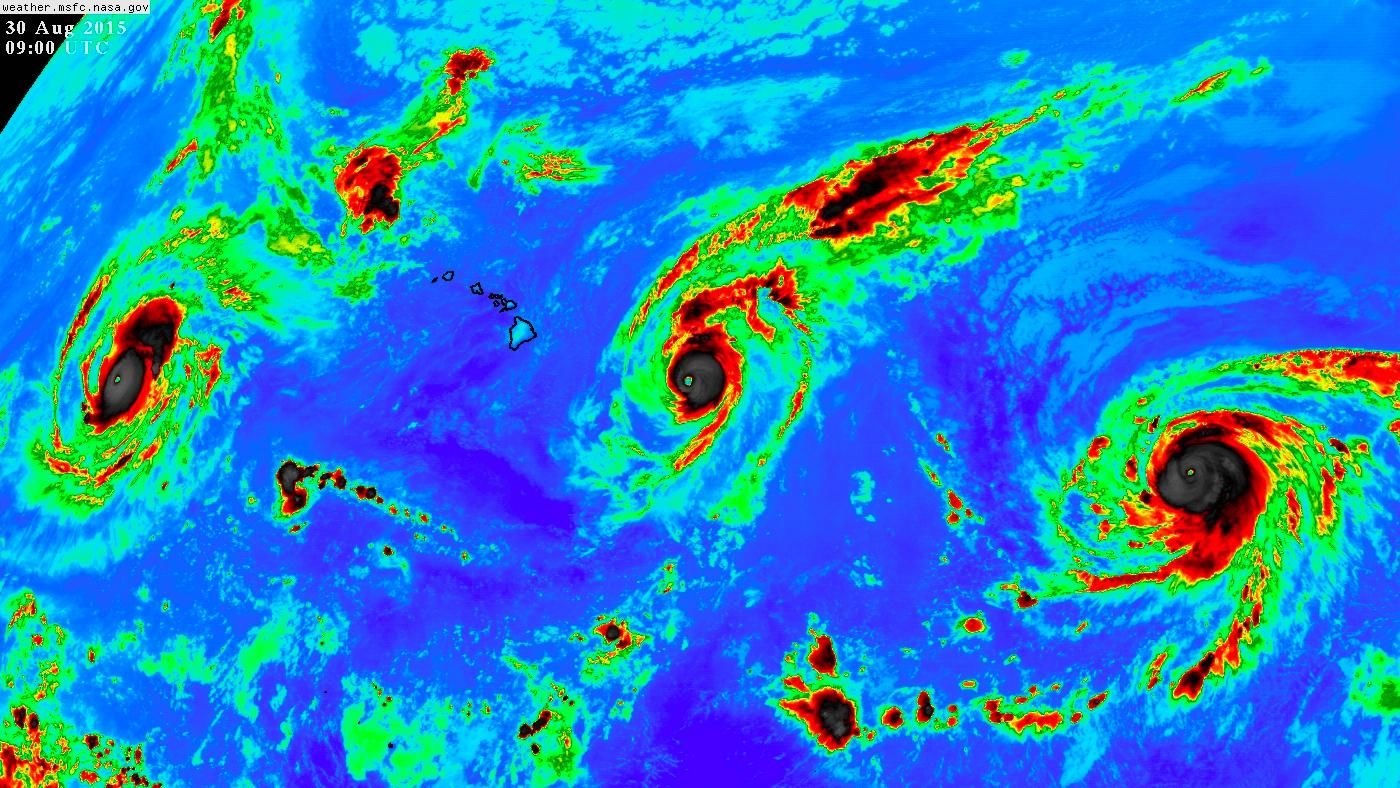
Kl. 23:00 EDT lørdag var orkanen Kilo (135 mph) lokaliseret godt sydvest for Hawaii øerne fulgt af orkanen Ignacio (140 mph) øst for Hawaii og orkanen Jimena (140 mph) i det østlige Stillehav. Kilo var den sidste af trioen til at opnå kategori 4 status, hvilket skete lørdag aften. Til information, orkaner med maksimale vedvarende vindhastigheder på 130-156 mph er klassificeret som kategori 4, som er den næsthøjeste kategori på Saffir-Simpson Orkan Vindskalaen.
Dog ved 17:00 tiden EDT søndag var både Kilo og Ignacio begyndt at svækkedes og klassificeret som kategori 3 orkaner, mens Jimena opretholdt kategori 4 status.
Dette er første gang at en sådan begivenhed er målt med tre kategori 4 orkaner i det centrale og øslige Stillehav på samme tid. Yderligere er det også første gang med tre større orkaner (kategori 3 eller stærkere) i disse vande på samme tid, ifølge orkanspecialist Eric Blake ved the National Hurricane Center.
Kommentar: Vi undskylder at resten af artiklen er på engelsk. Hvis du har lyst til at hjælpe med at oversætte, så skriv blot til sott_da@sott.net
Dr. Phil Klotzbach of Colorado State University and blogger for wunderground.com said in a tweet on Saturday that this was also the first time the central Pacific, bounded by the International Date Line and 140 degrees west longitude, has had two major hurricanes (Kilo and Ignacio) ongoing at the same time. This piles on to what has already been a record hurricane season in the central Pacific basin.
Blake said on Aug. 21 that Loke was the record fifth named storm to form in the central Pacific basin this season. The others were Ela, Halola, Iune and Kilo. In addition, three eastern Pacific storms have tracked through the basin, including Guillermo, Hilda and Ignacio.
NOAA's 2015 Central Pacific hurricane season outlook cited El Nino's tendency for reduced wind shear and more storm tracks coming from the eastern Pacific as reasons to expect an active season in the central Pacific Basin.
The Pacific tropical activity can be attributed, in part, to impressively warm ocean water.
El Nino is an anomalous, yet periodic, warming of the central and eastern equatorial Pacific Ocean. For reasons still not well understood, every 2 to 7 years, this patch of ocean warms for a period of 6 to 18 months.
The eastern Pacific basin also typically sees an increase in named storms during a moderate to strong El Nino thanks to diminished vertical wind shear.
The opposite is true in the Atlantic basin, since wind shear tends to increase in a moderate to strong El Nino, particularly in the Caribbean Sea.


Læserkommentarer
dig vores Nyhedsbrev