
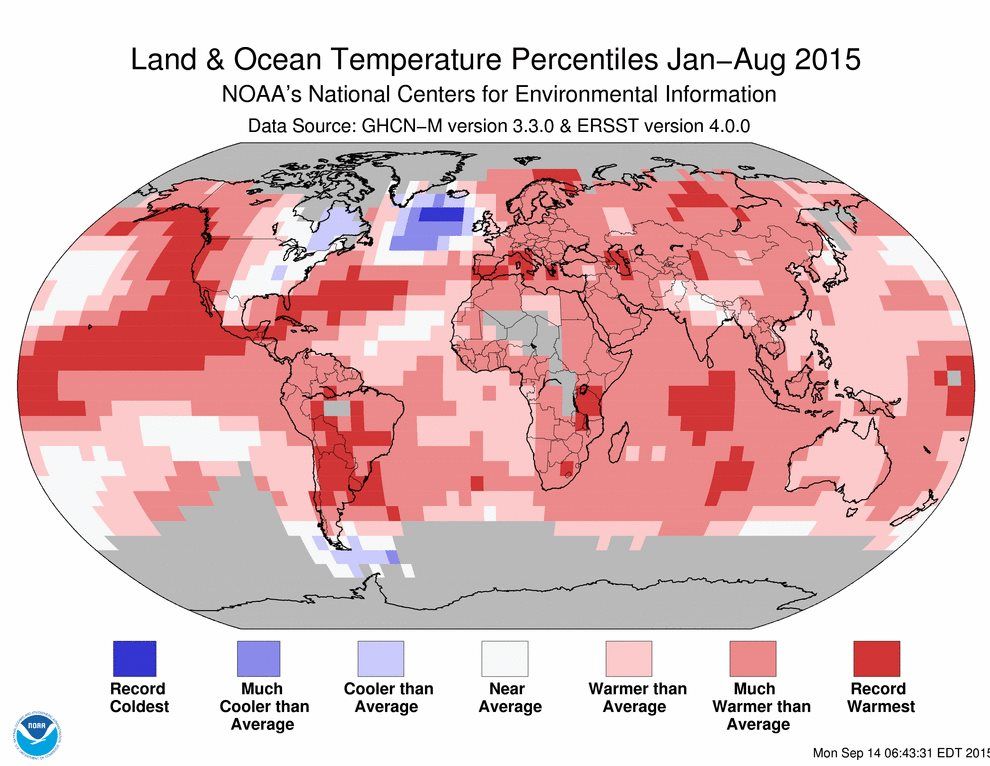
© National Oceanic and Atmospheric AdministrationJanuary–August 2015 Blended Land and Sea Surface Temperature Percentiles.
I sidste uge lærte vi således fra den Nationale Hav og atmosfære administration (NOAA) at de første otte måneder af 2015 var de varmeste på stribe som var blevet målt for jordens land og havoverflader, baseret på temperaturmålinger som strækker sig tilbage til 1880. Det er blot de seneste beviser som vi har der tegner på et rekordvarmt år i 2015.
Dog, hvis man kigger nærmere, så er der en del af kloden som går imod denne tendens. I det Nordatlantiske hav syd for Grønland og Island, har havets overflade set meget kolde temperaturer over de sidste otte måneder:
Hvad er der galt med det?
For det første er det ikke en fejl. Jeg tjekkede med Deke Arndt, chef for klimaovervågningsafdelingen af NOAAs Nationale centre for miljøinformation, som bekræftede hvad kortet ovenfor foreslår - visse dele af det Nordatlantiske hav så rekord kulde i de sidste otte måneder. Som Arndt sagde det i en email:
For gitterboksene i mørkeblåt, så havde de deres koldeste Januar-August nogensinde målt og for at en gitterboks kan 'få lov til' at komme med på kortet, så skal der være data for mindst 80 år af Januar - August perioder.Disse gitterbokse omfatter regionen fra "20V til 40V og fra 55N til 60N," forklarede Arndt.
Og der er ikke megen grund til at tvivle på målingerne - regionen er meget godt målt efter. "Den er ganske tæt besat af buoyer, og i det mindste en del af regionen har temmelig aktive søfartsruter, så der er en pæn del af observationer i området," siger Arndt. "Så jeg tænker at det er en ganske robust analyse."
Det vil sige at rekorden lader til at være en betydelig en - og der er et langt større tilstødende område, som selvom det ikke er absolut det koldeste som er målt, så dog usædvanlig koldt.
På det her tidspunkt er det tid til at spørge, hvad pokkerr sker der her. Og selvom der måske ikke endnu er et videnskabeligt konsensus om sagen, så er der i det mindste nogle videnskabsmænd so formoder at denne afkøling som kan ses på disse kort ikke er en tilfældighed, men nærmere del af en process som klimaforskere i lang tid har frygtet - en aftagelse af den Atlantiske havcirkulation. [Gulfstrømmen]
Kommentar: Vi undskylder at denne artikel er blot delvis oversat fra den engelske version: Surprising cold 'blob' found in the North Atlantic Ocean - astute climate scientists worried
Hvis du har lyst til at hjælpe vores lille frivillige stab med at oversætte til norsk, svensk eller dansk, så skriv blot til sott_da@sott.net
In March, several top climate scientists, including Stefan Rahmstorf of the Potsdam Institute for Climate Impact Research and Michael Mann of Penn State, published a paper in Nature Climate Change suggesting that the gigantic ocean current known as the Atlantic Meridional Overturning Circulation, or AMOC, is weakening. It's sometimes confused with the "Gulf Stream," but, in fact, that's just a southern branch of it.
The current is driven by differences in the temperature and salinity of ocean water (for a more thorough explanation, see here). In essence, cold salty water in the North Atlantic sinks because it is more dense, and warmer water from farther south moves northward to take its place, carrying tremendous heat energy along the way. But a large injection of cold, fresh water can, theoretically, mess it all up — preventing the sinking that would otherwise occur and, thus, weakening the circulation.
In the Nature Climate Change paper, the researchers suggested that this source of freshwater is the melting of Greenland, which is now losing more than a hundred billion tons of ice each year.
Comment: It's been going on a while now.
- Melting Of Greenland's Ice Sheet 'Is The Turning Point'
- Heat from Earth's Magma Contributing to Melting of Greenland Ice
I asked Mann and Rahmstorf to comment on the blue spot on the map above by e-mail. Here's what Mann had to say:
I was formerly somewhat skeptical about the notion that the ocean "conveyor belt" circulation pattern could weaken abruptly in response to global warming. Yet this now appears to be underway, as we showed in a recent article, and as we now appear to be witnessing before our very eyes in the form of an anomalous blob of cold water in the sup-polar North Atlantic.Rahmstorf also commented as follows:
The fact that a record-hot planet Earth coincides with a record-cold northern Atlantic is quite stunning. There is strong evidence — not just from our study — that this is a consequence of the long-term decline of the Gulf Stream System, i.e. the Atlantic ocean's overturning circulation AMOC, in response to global warming.I also asked Rahmstorf whether, if his thinking is right, we should expect this cold patch to become a permanent feature of temperature maps, even as the world continues to warm. His answer was complex, but not anything that gives you much reassurance:
The short term variations will at some point also go the other way again, so I don't expect the subpolar Atlantic to remain at record cold permanently. But I do expect the AMOC to decline further in the coming decades. The accelerated melting of the Greenland ice sheet will continue to contribute to this decline by diluting the ocean waters.Granted, it's not clear that all climate scientists agree with this interpretation of what's happening in the North Atlantic — but clearly some important ones do, and they have published their conclusions in an influential journal.
The longer the situation continues, the more it is likely to attract attention. But it has already been around for a while. "It's been really persistent over the last year and a half or so," NOAA's Arndt says.
Indeed, I spoke with Rahmstorf previously about the cold patch in the North Atlantic in March, when his study came out — and when a NOAA temperature chart for December 2014 through February 2015 also showed record cold in this area. As Rahmstorf wrote back then, "The North Atlantic between Newfoundland and Ireland is practically the only region of the world that has defied global warming and even cooled." Since then, the trend appears to have only continued.
So in sum, if Mann and Rahmstorf are right, a slowing of Atlantic Ocean circulation could be beginning, and even leaving a temperature signature for all to see.
This won't lead to anything remotely like The Day After Tomorrow (which was indeed based — quite loosely — on precisely this climate scenario). But if the trend continues, there could be many consequences, including rising seas for the U.S. East Coast and, possibly, a difference in temperature overall in the North Atlantic and Europe.
So on future climate maps, even as we rack up more hot months and years, we'd better watch the North Atlantic closely.



Kommentar: "This won't lead to anything remotely like The Day After Tomorrow [...]". Actually, it could.The Earth's climate can change on a dime.
- Last Ice Age took just SIX months to arrive
- Ice age on the way: Gulf Stream is slowing down faster than ever, scientists say
- Ice Age Cometh: Scientists fear 'Day After Tomorrow' climate change
There also seems to be a price for pursuing this line of inquiry:Global warning? Top UK climate scientist and expert on Arctic ice cries foul over colleagues' deaths